The Subscription
The Physical Possibility of Life in The Mind of Someone Dead (2023)
The Subscription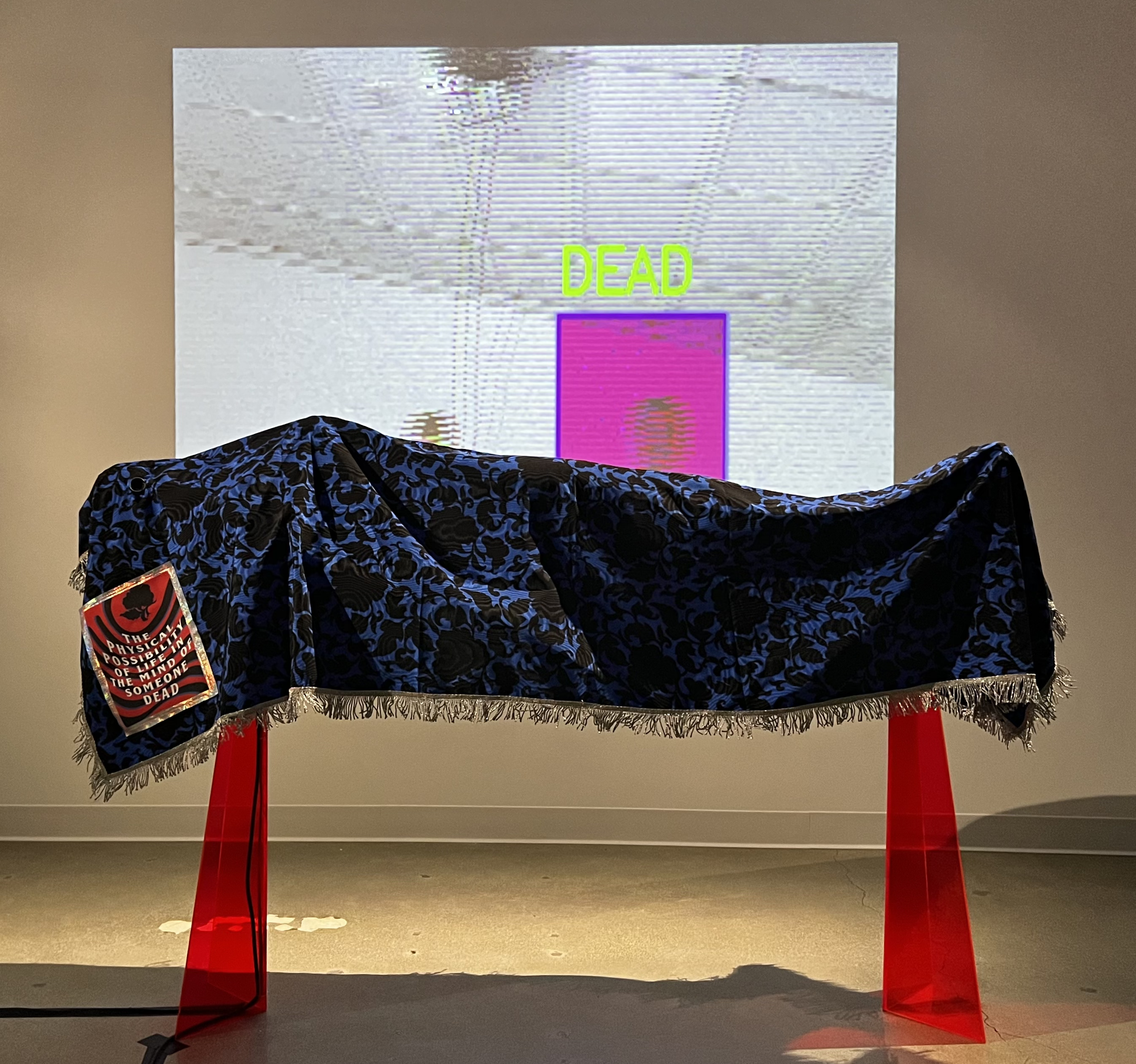
The Physical Possibility of Life in The Mind of Someone Dead (2023)
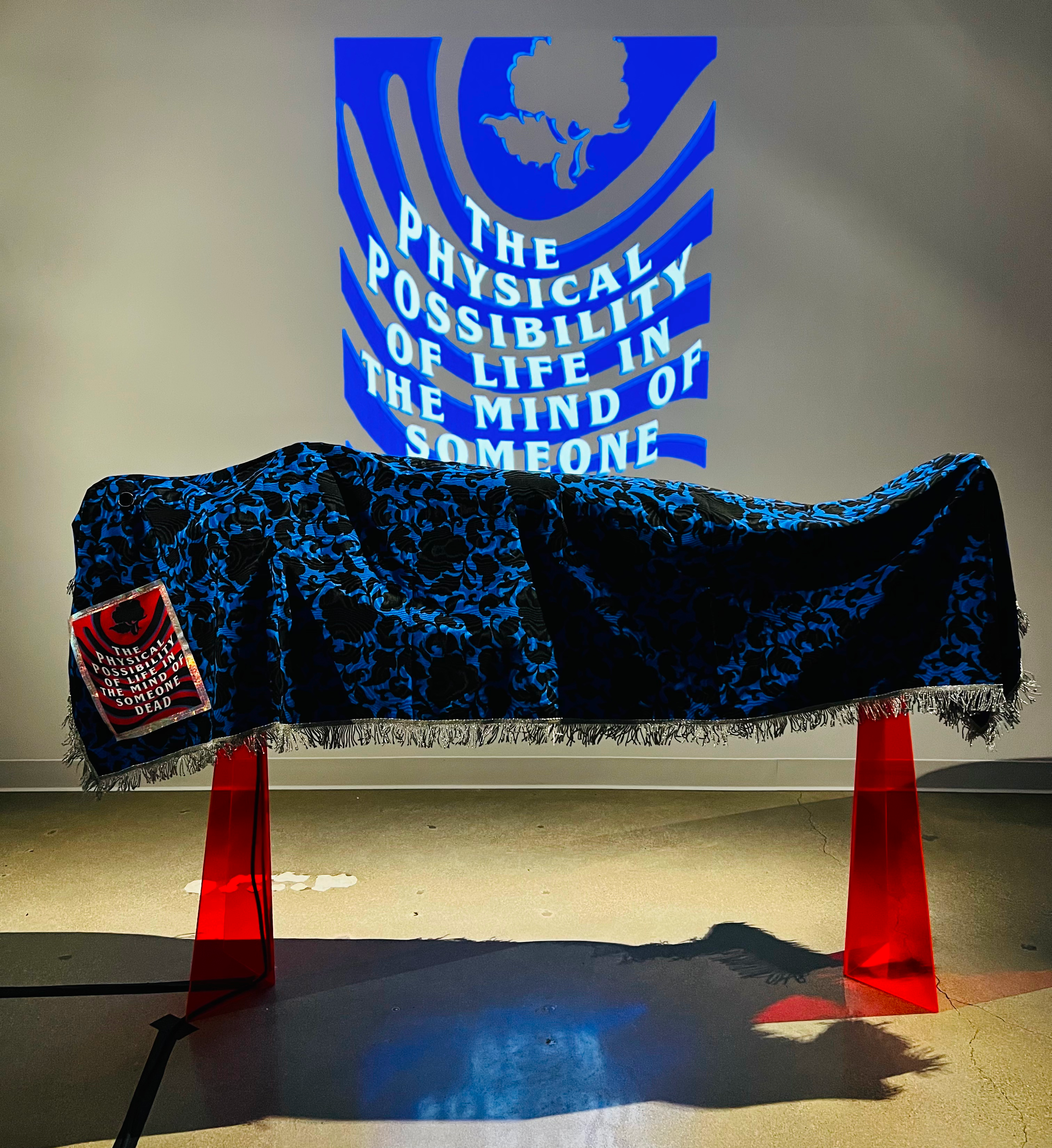
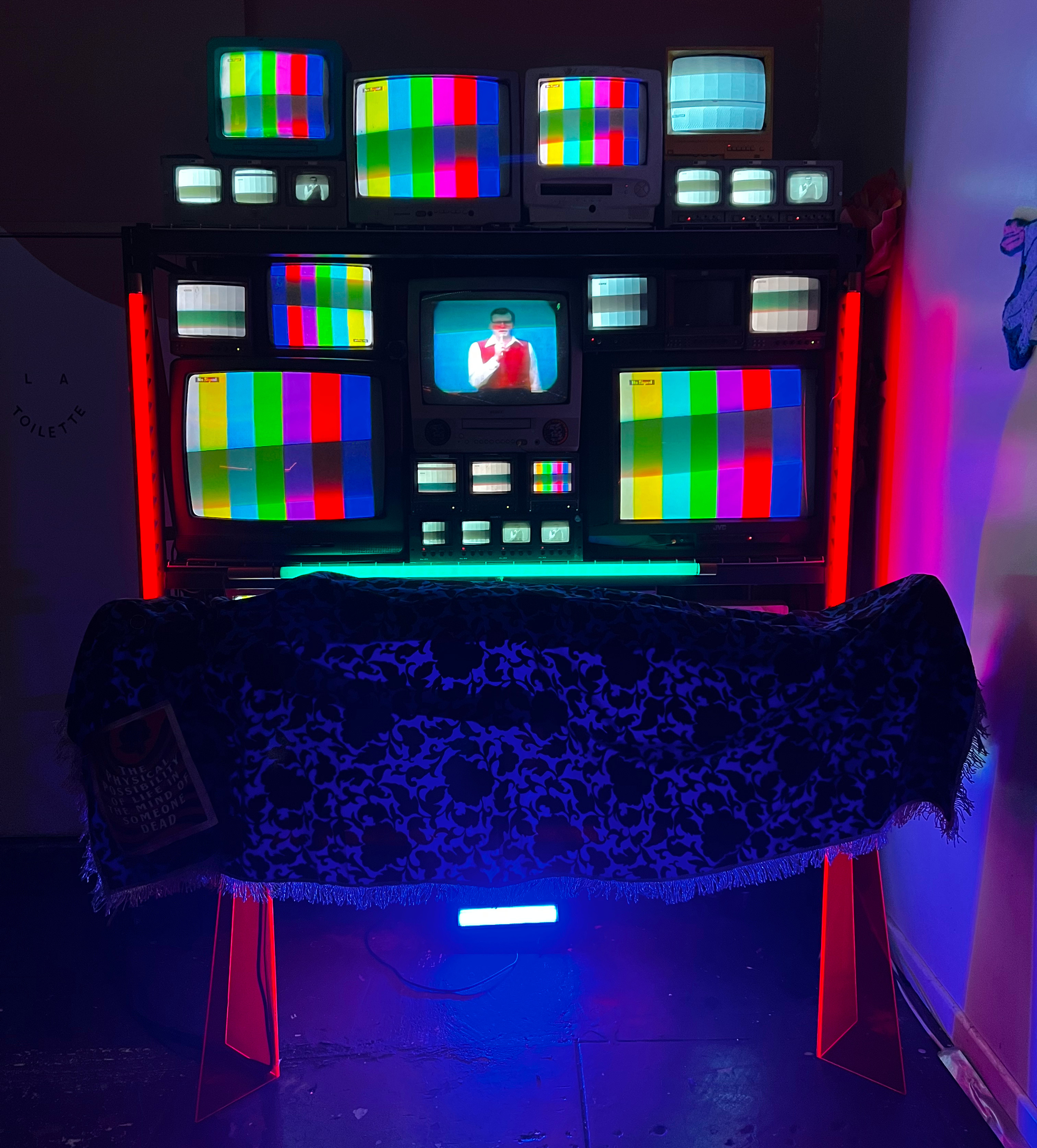
The SubscriptionA human form, entirely concealed by a floral shroud, floats approximately three feet off the ground, suspended between two plexiglass plinths. The chest rises and falls. A camera faces out from inside the head. The feed is processed inside the sculpture and screened on the wall behind it. Viewers are captured by the sculpture's vision, a border is drawn around their faces, and a label is affixed to their likeness. The label reads either "living," "dead," or "unknown." The plinths glow dizzying orange. The shroud bears a silvery sheen with Victorian frill. The video evokes the scanline abstractions of infrared surveillance. The Physical Possibility of Life in The Mind of Someone Dead is a computational, robotic, videographic, and textile-based sculpture originally fabricated by The Subscription in June of 2023 in Los Angeles, California.
In Poe's The Fall of The House of Usher, the tragic folly of Roderic Usher and his narrator accomplice is to bury Madeline Usher alive. Having mistaken her living body for a corpse, the two men deposit her in a locked catacomb beneath the family estate, where (spoiler) she doesn't remain for long. Madeline's false mortis is chalked up to a diagnosis of "catalepsy," a disease-as-plot-device employed in a number of Poe's stories. The best example is The Premature Burial, but related themes feature in The Cask of Amontillado and The Pit and The Pendulum. Catalepsy's presentation boils down to a single overarching condition: You look dead. In a cataleptic state, the body appears to be in rigor, unmoving (unless moved by someone or something else), expressionless, and stiff. Poe was excessively hypochondriacal, personally suspecting himself to be afflicted by catalepsy, which is no longer recognized as a real disease, except as a symptom of certain schizophrenic conditions. Poe certainly suffered a number of medical issues, and some of them remain vague, but the fear of accidental burial due to a catalytic episode had an outsized influence on his near-constant anxiety. Without EKGs, without defibrillators, without detailed x-rays and nuanced concepts of the nervous system's fragility, without vital-sign measurements that were either not possible or not reliable near the turn of the century, western medicine lacked its modern, unflappable confidence in a clear, identifiable boundary concerning life and death. A nearly dead person might indeed have been mistaken for a recently dead person, and to grizzly consequence. This was why gizmos like "the coffin bell" arose, for sneakily alive casket tenants to ring from beneath the soil, alerting the no doubt on-edge cemetery attendants to their grave misfortunes. Some tombs came equipped with "sniffing tubes," where a worker in the enviable position of corpse smeller could confirm through olfactory evidence the rapid decay of an actual corpse as opposed to the milder aromas of an inadvertently interred cholera sufferer. There were even temporary quarantine ossuaries where a falsely deceased individual could simply open the vault door and let themselves out. All of these preventative measures -- ineffective as they proved (because if one is easily conflated for a dead body, after all, one is generally too weak to do anything but die once sealed inside a coffin, even a "safety coffin," as these provisional vessels were dubbed) -- soon became novelties, and today we are left with the fear of live entombment as either a metaphor or stopgap phobia. The thought stands in for the unimaginable circumstance of sensory experience enduring past the termination of life. Death's void, inasmuch as it annihilates the ego and the self, is more mysterious, and even, to some, alluring, than it is terrifying. Religious or spiritual afterworlds similarly offer the welcome gift of absolution. But the notion that we are not annihilated, and nor do we transcend, but we simply inhabit the blunt state of death in a manner similar to how we live, this is also a possibility.
In novelty stage shows of all kinds, gender assignments track the formula of the charismatic male performer and the timid, or even silent, female model. The male magician will make the woman disappear, or he'll saw her into two halves, generally with the intention (we hope) of restoring her to unity shortly thereafter or revealing her presence in an unexpected hideaway such as behind a curtain. These ultra-passive performers are damsels in distress, contradictorily redeemed by the heroism of their captors, to whom they have nervously volunteered their normative beauty as collateral of such vaulted worth that no audience would ever doubt the expertise of the magician in charge. Even if the majority of viewers (especially when these acts are broadcast on television or the internet) believe the magician's model to be, in fact, "in on it," what does that change? Given the assumption that "magic isn't real," it would also follow that "getting sawed in half is dangerous," so who is the crueler audience: the gullible, or the shrewd? Some go in fans. Some go in skeptics. Everyone comes out having participated. In the world of show hypnotism, the "magic" is often performed on a small assembly of audience volunteers. In this way, the performance tantalizes onlookers by perpetually teetering at the edge of a nonconsensual orgy. In a mesmerized state, adult volunteers act like children and animals. They flail around, inappropriately touch one another, and usually only almost indulge in their basest desires, all while watched over smirkingly by the proverbial do-whatever-you-want-as-long-as-it-stays-in-the-house cool dad, the hypnotist. The viewers, too, tend to get pretty mesmerized by this reality show meets side show, because maybe they'll see something they like, or maybe they'll get marginally unsettled into suddenly having a new thought. Either way, a Long Island Iced Tea is sure to help them get in the zone. In the above scenario, the gender presentation of the performer/subject/model/volunteer group is generally more varied than in stage magic, but if the drama of these acts lies in some implied social, sexual, or physical danger, then the female-presenting stagehands are the ones who are in it, and the men are there to cause it. The spellbound women are cast as potential victims, where the spellbound men become potential weapons, or maybe they are soldiers in the service of the hypnotist, because isn't he in control of it all? Cataleptic hypnosis is a particularly extreme example of hypnotic patriarchy, as well as a distillation of the form's chaotic frenzy back into the anxious intimacy of traditional stage magic. In a one-on-one, or two-on-one, display, the hypnotist guides the subject into a state of closed-eye paralysis by tapping on her body from head to toe while repeating the command to go "rigid and stiff," "like a steel rod," or "like an oak board." The hypnotist keeps tapping and talking until the subject appears basically unconscious, without reflexes, and mostly impervious to any type of prodding or bending that might cause an unhypnotized person to physically recoil. At this point, usually with the aid of an assistant, the subject is pushed into a trust fall (supposedly more impressive because no trust is required), caught by the hypnotist, and lifted into a position where her body is bridged between two chairbacks or stools or other narrow supports. Her feet rest on one, head on the other, and the entire length of her torso and legs are suspended between the two, just like a steel rod, wow! Some acts leave the spectacle at this, a supposed demonstration of the power of the mind over the body. The skinny female model, it's implied, could never do this on her own. No level of Pilates could induce such core strength in someone so meek. It must be magic, or, rather, it must be the magic of hypnotism. But wait! There's one more small step mankind insists on taking. Oftentimes, the hypnotist will go on to display the sheer inhuman stiffness they've been able to coerce their subject into by standing on her bridged stomach, either momentarily or for a good deal of time, triumphant atop the prostrate woman's body. The hypnotist reliably seizes this opportunity to expound to the audience on the staggering power of his subject's mind that she's achieved such a wooden and submissive position. All he has done is bring out her true nature, that of a human floorboard. This practice is genuinely dangerous and has resulted in many injuries and at least a few deaths. Should the model -- not in reality benefiting from any supernatural assistance or subliminal miracles, but actually supporting the weight of a standing man with her abdominal muscles -- let go and collapse, a medical emergency would ensue, and it has. Cataleptic hypnosis performed in public is banned in the United Kingdom by parliamentary act, and to be fair, it is frowned upon by all serious hypnotists across the globe (the study and practice of hypnotism, without the "show" part, is probably not too much more sexist than therapeutic culture as a whole). You know what they say, though: cataleptic hypnosis happens. Clandestine or not, performers all across the world dazzle, or simply confuse, audiences with this strange, brow-wrinkling gimmick. Setting aside the physical abuse, the optics alone are difficult to ignore, but apparently, they're easy enough to indulge in. In both this essay and in our sculpture, we appear to have indulged them.
OpenCV stands for "Open-Source Computer Vision," which is a python library that uses machine learning to process images or video, either recorded or in real time. It isolates objects in the pixel space and cross-references them against its trained recognition algorithms. Amateur and professional programmers throughout the internet employ shared or personal GPUs to train new OpenCV models on swaths of visual data, usually adding new, specific recognition capacities to the library, such as fish or birds or dental tools, resulting in an ever-more complete ability for OpenCV-based programs to symbolically interpret the world in a human-legible fashion. This is, in some ways, the overall work of machine learning and artificial intelligence, though OpenCV tends further toward "learning" than "intelligence" because its primary operations are interpretive rather than predictive. Of course you could use OpenCV for predictive purposes in the way that PredPol uses "neutral data" to predict where crimes will occur and relocate police cruisers to those "geofences" before they happen (PredPol's website can't be accessed under a VPN, and we're absolutely not going there without one, but according to a 2020 report, their software is in use by over 60 mid-sized American police departments, with one example of "mid-sized" being Mountainview, California), but this tends to be where human habit and cultural bias winds up egregiously replicated. On the other hand, interpretation has its biases too. OpenCV's facial recognition models will identify gender and even compile a percentage ratio of the predominant emotions in a person's expression. Functionally, OpenCV has both surveillant and sousveillant capabilities, but the fact that it is costless, open-sourced, and agile enough to run smoothly on workaday laptops, means it lends itself to hobbyists and hackers, and not to corporate interests. Theoretically, too, massively invasive, militaristic surveillance programming requires proprietary source code and therefore -- barring some kind of logically inescapable PSYOP double-bind -- OpenCV couldn't be effectively harnessed towards weaponized or carceral ends. US and Israeli programs like Elbit and Anduril (these companies change their names, for obvious reasons, kind of a lot) use facial recognition algorithms to determine "necessary" actions at the US-Mexico border and the West Bank respectively. The function of these programs is to simultaneously expedite and legitimize apartheid violence using a black-boxed technology that never has to explain itself due to the assumed objectivity of data-driven technology. If these datasets or programs were open sourced, and anyone capable of interpreting the file could see them, they would be significantly less black-boxed, more explained, and their objectivity would not need to be assumed. Without access to the machine learning surveillance programs of the optocratic military industrial complex, it is difficult to know how much more capable those are than the open-source alternatives like OpenCV, but our uses of the program have so far been simple. Our sculpture has a full release of OpenCV downloaded onto a micro-SD card housed inside its torso. The sculpture uses OpenCV to label the viewer either living, dead, or unknown. Candidly, the panorama of the sculpture's machine view, along with its ultimate judgements, are screened behind it for all to see. Do you agree with the sculpture's assessment? Do you need an explanation?